
Meta Description: Running out of storage space? Discover how 7 industries — from hospitals to museums — use mobile shelving systems to double capacity, improve security, and cut real estate costs. Updated for 2026.
Why Static Shelving Is No Longer Enough
If you’ve ever stared at a wall of overflowing filing cabinets and wondered where the next decade of records will go, you’re not alone. Organizations across every sector hit the same storage wall eventually: static shelves fill up, floor space runs out, and moving to a larger facility costs a fortune.
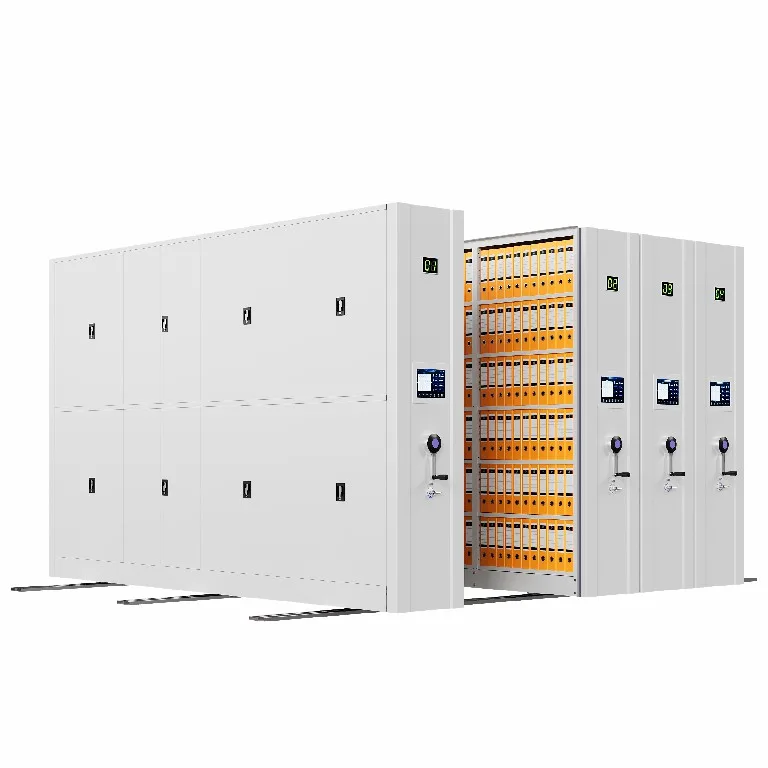
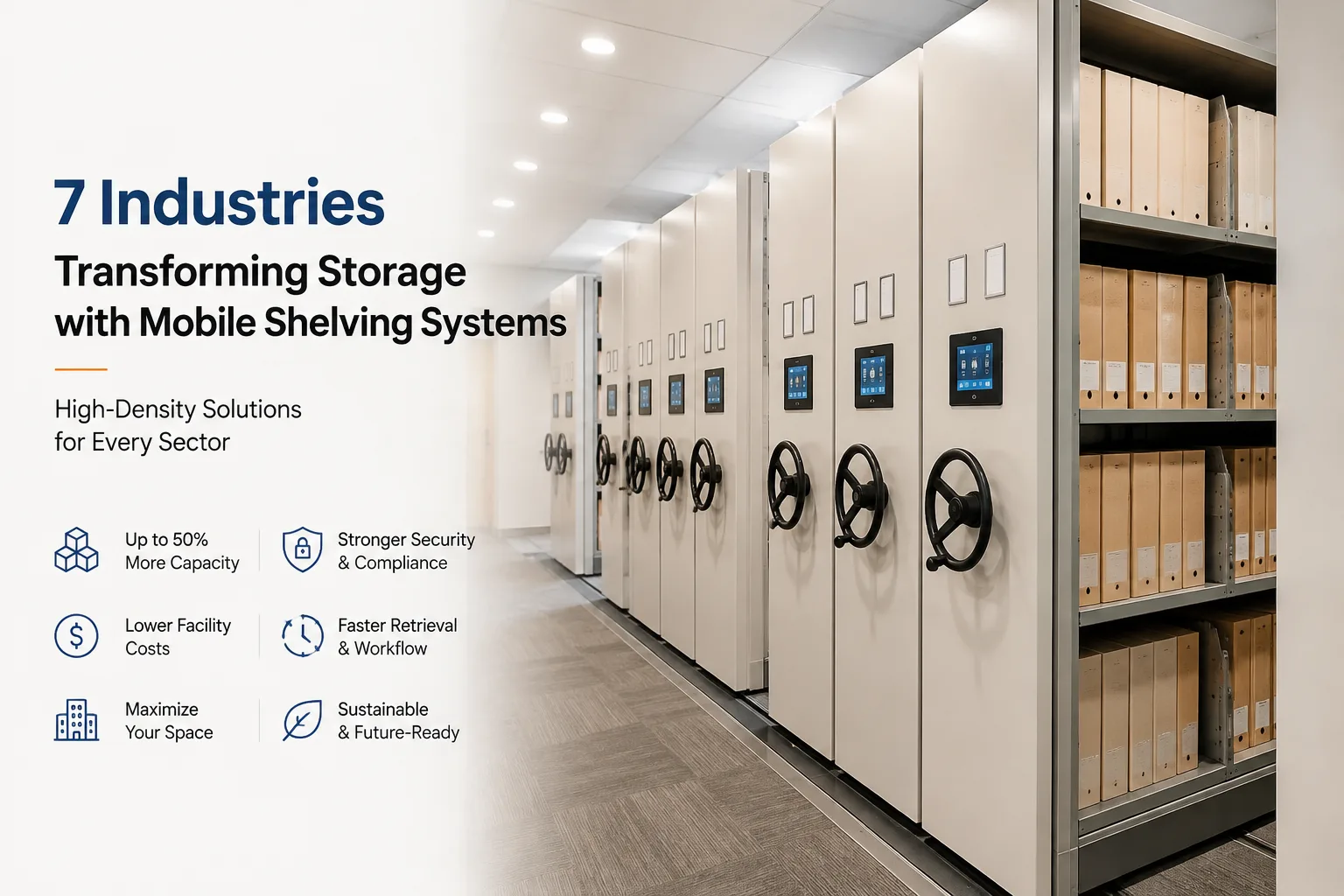
Mobile shelving systems solve this problem by eliminating wasted aisle space. Instead of needing a permanent walkway between every row, shelves glide along tracks, so you only open an aisle where you need it. The result?
Up to 50% more storage capacity in the same footprint.
But the benefits go far beyond just fitting more boxes. Different industries use mobile shelving to solve very specific challenges — patient privacy in hospitals, artifact preservation in museums, litigation readiness in law firms. Below, we break down how seven distinct sectors leverage high-density mobile storage to solve their unique pain points.
1. Corporate & Government Archives: Security Meets Compliance
Companies and government agencies are drowning in paper. Compliance rules mandate retaining financial records, employment files, contracts, and internal communications for years — sometimes decades. And it’s not just about volume; sensitive and classified material requires strict access control.
Mobile shelving addresses both challenges at once. Centralized locking systems secure entire rows with a single point of control, ensuring only authorized personnel can access restricted archives. Meanwhile, compacting rows means you can store significantly more records without expanding your physical footprint — a huge advantage in urban office buildings where every square foot carries premium rent.
Typical applications: Audit trail records, HR personnel files, procurement contracts, litigation hold documents, classified government archives.
UFUN Insight: Many organizations underestimate how much they’ll save by avoiding a move. If you’re paying $30+ per square foot annually for office space, reclaiming 40% of your storage room pays for the system in years, not decades.
2. Libraries & Research Institutions: Preserving Access While Expanding Collections
Libraries face a storage paradox that’s almost unique to their field: they must keep everything — including rarely circulated back issues, thesis archives, and special collections — while also making room for new acquisitions and community programming space every year.
Mobile compact shelving is tailor-made for this challenge. Libraries consolidate low-circulation materials into high-density storage, freeing up prime floor space near reading areas and entrances for study rooms, maker spaces, or high-demand collections. Academic and research libraries especially rely on mobile shelving for periodical archives, government document depositories, and rare manuscript collections where both preservation and space efficiency matter equally.
Typical applications: Periodical back-catalogs, dissertation and thesis archives, special collections, government document repositories, rare book storage.
3. Healthcare & Medical Records: Confidentiality That Scales
Despite the shift to electronic health records (EHRs), hospitals and clinics still maintain massive physical archives: diagnostic imaging film, signed consent forms, insurance paperwork, and legacy paper charts from before digitization. With retention requirements of 7–10+ years (and even longer for pediatric records), these archives just keep growing.
Mobile shelving gives health information management teams a secure, compliant way to store dense volumes of patient files. Centralized row locking supports patient confidentiality requirements (such as HIPAA in the U.S. and GDPR in the EU), and consistent indexing structures make retrieval fast even when you’re pulling files from years ago. Given how expensive hospital real estate is, converting static file rooms to high-density mobile storage is one of the most cost-effective compliance investments a healthcare system can make.
Typical applications: Legacy paper charts, diagnostic imaging archives, consent and intake forms, billing and insurance documentation, research study records.
4. Education & Campus Administration: Doing More With Less
Schools and universities generate mountains of paperwork — student transcripts, admissions files, disciplinary records, departmental archives, plus library-grade collections like academic journals and institutional publications.
The catch? Campus space is almost always allocated to classrooms and student-facing facilities first. Administrative records departments usually end up in the smallest, most awkward rooms on campus. Mobile shelving lets registrar’s offices, admissions departments, and archives teams store decades of records without begging facilities management for more square footage from an already tight budget.
Typical applications: Student transcripts and academic records, admissions applications, institutional archives, departmental administrative files, research lab records.
5. Law Firms & Legal Services: Retrieval Speed Is Everything
In the legal world, being able to find the right document at the right moment isn’t just convenient — it’s case-critical. Active case files, discovery documents, evidence logs, and client records can span years or even decades, and firms handling litigation often need to store massive volumes for both active and closed matters simultaneously.
A well-organized mobile shelving system with a clear indexing structure makes it dramatically faster for legal staff to locate specific case files. Centralized locking protects privileged and confidential client information — an ethical requirement, not just a nice-to-have. And because firms can store years of closed-case archives on-site instead of off-site storage, retrieval happens in minutes, not days.
Typical applications: Active and closed case files, discovery documents and evidence, client engagement records, litigation holds, regulatory compliance files.
6. Museums & Cultural Heritage: Preservation First, Organization Second
Museums and cultural institutions face a storage challenge that combines two competing priorities: protecting fragile, often irreplaceable objects, while keeping them organized and accessible to curators and researchers.
Mobile shelving in museum settings is highly customizable — modular shelf depths and heights accommodate everything from flat files for artwork and textiles to oversized containers for historical artifacts. Many institutions pair mobile shelving with dust-proof or humidity-resistant configurations to protect sensitive collections stored long-term. The space savings also mean museums can keep more of their collection on-site rather than in off-site facilities, making curatorial work far more efficient.
Typical applications: Collection catalogs, conservation and restoration records, special collections storage, historical artifact housing, artwork flat files.
7. Engineering & Industrial Archives: The Physical Backup Layer
Not every high-density storage need is about traditional paper documents. Engineering firms, manufacturing plants, utilities, and public works departments often need to retain physical copies of blueprints, as-built drawings, compliance documentation, and legacy contracts — even in an increasingly digital world. Sometimes it’s a regulatory requirement; sometimes it’s because 40-year-old drawings were never digitized.
For these organizations, mobile shelving serves as the physical backup layer to digital document management systems — organized, high-density storage for the paper trail that regulators, auditors, or engineering teams may need to reference decades later. Wide-format shelving configurations accommodate oversized drawings and blueprints that don’t fit standard document boxes.
Typical applications: Engineering drawings and blueprints, as-built documentation, compliance records, legacy contracts, regulatory audit trails.
Quick Match: Which Configuration Fits Your Industry?
While the core mobile shelving mechanism is universal, the optimal setup varies significantly by use case:
| Industry | Top Priority | Recommended Configuration |
| Government / Corporate Archives | Security & compliance | Centralized locking, restricted-access rows |
| Libraries & Research | Flexible capacity | Adjustable shelf depth, mixed media storage |
| Healthcare / Hospitals | Confidentiality & compliance | Locking rows, standardized indexing |
| Universities & Schools | Space efficiency | Standard manual or electric operation |
| Law Firms | Fast retrieval & security | Clear indexing system, centralized locking |
| Museums & Archives | Preservation | Dust-proof / humidity-resistant, custom sizing |
| Engineering / Industrial | Oversized storage | Wide-format shelves for drawings & blueprints |
At UFUN, our mobile shelving systems support manual, electric, and smart operation modes — all with fully modular shelf configurations. That means the same core platform can be customized for a corporate archive, a university library, or a museum collection storage room, instead of forcing every customer into a one-size-fits-all layout.
Frequently Asked Questions
Q: How much space can mobile shelving actually save?
A: Most installations achieve 40–50% more storage capacity compared to static shelving with fixed aisles. The exact number depends on your row count and aisle configuration, but doubling capacity in the same footprint is common.
Q: Can one system handle multiple types of materials in the same facility?
A: Absolutely. Because mobile shelving uses modular shelves with adjustable heights and depths, a single installation can have different rows configured for different needs — standard document boxes in one section, oversized blueprints or bound periodicals in another.
Q: Do hospitals need a special medical-grade mobile shelving system?
A: The core mechanism is the same, but healthcare facilities should prioritize configurations with centralized locking and standardized labeling to support patient confidentiality and compliance requirements. Stainless steel options are also available for sterile environments.
Q: Is mobile shelving safe for fragile or sensitive archival materials?
A: Yes — especially when configured with dust-proof enclosures, humidity control options, or non-abrasive shelf surfaces. Many manufacturers, including UFUN, offer specialized configurations for museums, libraries, and archives storing delicate or rare materials.
Q: How long does installation take?
A: A typical office or archive installation takes 1–3 days depending on size. Larger installations (full libraries, hospital record rooms) may take a week or more. Most installations can be phased to minimize disruption to daily operations.
Ready to Reclaim Your Storage Space?
Every industry stores different materials, faces different compliance rules, and needs different levels of security — which is why a cookie-cutter mobile shelving system rarely delivers optimal results.
At UFUN, we design custom high-density storage solutions tailored to your specific industry, space, and budget. With over 10 years of manufacturing experience and installations across 20+ countries, we’ve helped organizations from corporate archives to university libraries double their storage capacity without moving an inch.